

Subject Guides
How to Start an IGCSE Maths Question When You Feel Stuck
A practical first-minute approach to unfamiliar maths questions: mark what is known, name the goal, and choose one valid step.
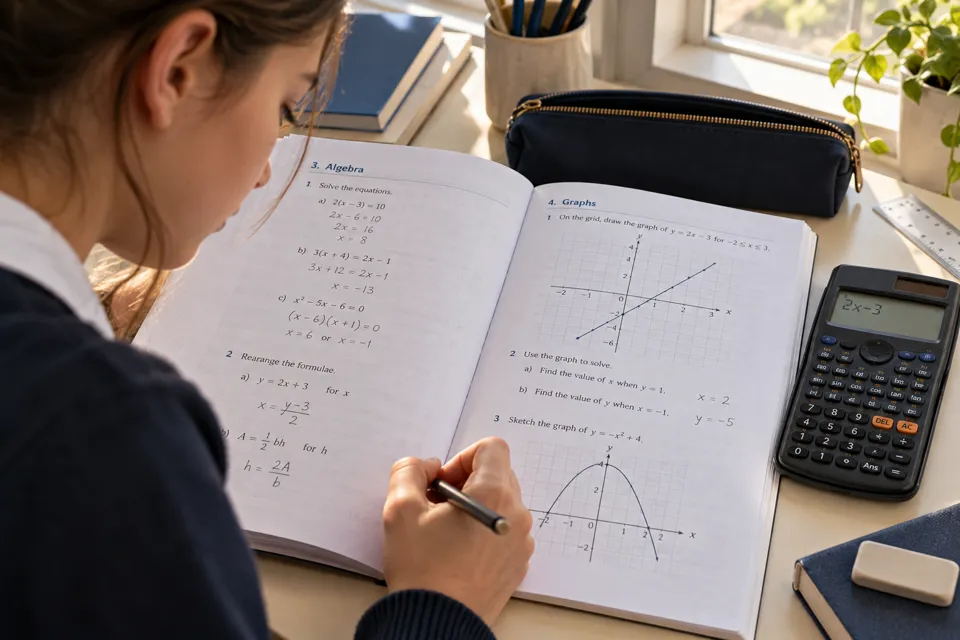
A long mathematics question can make familiar ideas look unfamiliar. The first step is often not a formula. It is making the question smaller.
Circle what is given and underline what is wanted
Before calculating, identify the quantities, units, diagram labels, and conditions. Then write a short target beside the question: “find the gradient,” “show these are similar,” or “work out the total cost.” This stops you from doing correct mathematics that does not answer the question.
Choose one relationship you trust
If the question gives two points on a line, you may know how to find a gradient. If it gives an angle and two sides in a right triangle, you may know a trigonometric ratio. Write down that relationship even if you cannot yet see the full route. A valid first step can reveal the next one.
For word problems, sketch a simple diagram or table. Label it with the information given. You are not trying to make it beautiful; you are making the relationships visible.
Check whether your answer makes sense
When you reach a result, put it back into the question. Is the unit right? Can a length be negative here? Does a percentage above 100 make sense in this context? A quick estimate can catch a misplaced decimal or an operation chosen too quickly.
If you still cannot finish, leave your labelled diagram and correct working on the page, then move on. In practice, use the mark scheme afterwards to locate the exact step where your route stopped. That is the part to revise.